Table of Contents
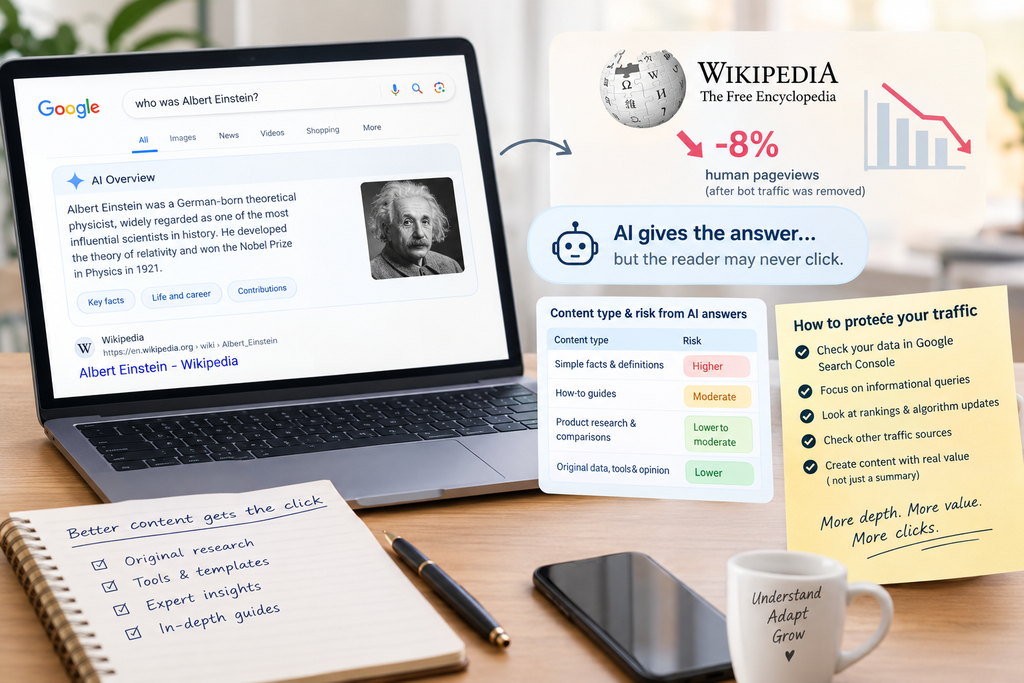
Wikipedia is one of the most trusted websites on the internet. So when its visits fall, every site owner should pay attention. The story of AI Overviews and web traffic is not just about small blogs losing clicks. It also reaches the biggest names online.
I haven’t tracked a client’s traffic myself, so I won’t pretend to have a case study. What I can do is share what I’ve observed, combine it with public data, and show you a practical way to check your own numbers.
What Wikipedia’s Numbers Actually Show
The Wikimedia Foundation, which runs Wikipedia, reported that human pageviews fell by roughly 8% compared with the same months in 2024, after it revised how it classifies bot traffic. The Foundation believes this reflects the impact of generative AI and social media, especially search engines that give answers directly, often based on Wikipedia content. Wikimedia FoundationWikimedia Foundation
That last point is the irony. AI answers often draw on Wikipedia, but the reader may never click through.
There’s an important detail here. The drop only became visible after the Foundation updated its detection systems and found that sophisticated bots, many from Brazil, had been posing as human visitors. In other words, the “real” trend was hidden until the data was cleaned up. yahoo
A note on certainty
Be careful with the cause. One independent analysis reminds readers that correlation is not causation, and that factors like Google algorithm changes and mobile browsing trends also affect Wikipedia traffic. Even the Foundation says it believes AI and social media are behind the decline.ai overviews and wed traffic It has not proven this with a controlled test. GitHub
Why Informational Searches Take the Hit
From what I’ve observed, informational searches feel the pressure first. When someone asks “who was [person]?” or “what is [concept]?”, an AI answer can satisfy them on the spot. That leads to more zero-click searches and fewer visits.
Wikipedia is built for exactly that kind of question. Here is how different content types tend to be exposed:
| Content type | Risk from AI answers | Why |
| Simple facts and definitions | Higher | A short summary often answers the whole question |
| How-to guides | Moderate | Users may still want detail, examples, or visuals |
| Product research and comparisons | Lower to moderate | People often want to verify and compare on real sites |
| Original data, tools, and opinion | Lower | AI can’t easily replace unique value |
This table reflects my own observations and reasoning, not a formal study. Your results may vary by industry and query type.
What Wikipedia’s Story Means for Your Site
The lesson is simple: even trusted, information-rich websites can lose visits when answers appear directly in search. Authority alone doesn’t guarantee the click.
What earns the click is a reason to go further. That means content offering something a short summary can’t, such as:
- Original research or first-hand experience
- Templates, tools, or calculators
- Clear opinions backed by evidence
- Depth that goes beyond the basic answer
The Foundation also warns that fewer visits could threaten community engagement and donations. If a giant nonprofit feels that pressure, a small publisher should plan for it too. AI Insider
How to Check Whether AI Overviews Are Hurting Your Traffic
Here is the process I’d follow. It starts with the data, not with assumptions.
- Pick a clear before-and-after window. Compare traffic and click-through rates (CTR) before and after AI Overviews appeared for your queries.
- Focus on informational queries. These are the most likely to be affected.
- Check Google Search Console. Look at clicks, impressions, average position, and CTR for your key pages.
- Look at rankings. If positions fell, the cause may be traditional ranking loss, not AI.
- Review algorithm updates. Line up your traffic dates against known Google updates.
- Check other traffic sources. Social, email, and direct traffic can show whether the drop is only in search.
A useful pattern to watch for is stable impressions with falling clicks. That can suggest people see your result but get their answer elsewhere. It’s a clue, not proof.
The biggest mistake: blaming AI Overviews too fast
In my view, the most common mistake is assuming every traffic drop comes from AI Overviews. Wikipedia’s own case shows why. Its numbers were distorted by bots, and outside factors also played a role. If you skip the diagnosis, you might miss a real problem, like a ranking drop, a technical error, or an algorithm update.
Your 30-Minute Action Plan
If you only have half an hour this week, do this:
- Open Google Search Console and review clicks, impressions, rankings, and CTR on your key informational queries.
- Identify which pages are losing traffic.
- Improve those pages with unique, useful information that AI answers may not fully provide, such as original examples, data or expert insight.
Then repeat monthly. Small, steady updates beat a panic rewrite.
Frequently Asked Questions
Do AI Overviews reduce website traffic?
They can, especially on informational queries where the answer appears directly in search. The effect varies by site and topic, so check your own data.
Why did Wikipedia’s traffic fall?
The Wikimedia Foundation points to generative AI and social media as likely reasons, but it hasn’t proven a single cause.
How can I tell if AI Overviews affect my site?
Compare click-through rates before and after, focus on informational queries, and rule out ranking drops and algorithm updates using Google Search Console.
Should I stop writing informational content?
No. Make it more useful and unique so readers have a reason to click.
Conclusion
The connection between AI Overviews and web traffic is real, but it isn’t always simple. Wikipedia shows that trusted sites can lose visits, and that the true cause can take time to untangle. Start with your own data, rule out other explanations, and strengthen the pages that matter most with content AI summaries can’t fully replace https://shikhav.com/