Table of Contents
If you’ve felt uneasy about AI job losses, you’re in good company. A new Pew Research Center survey shows that in most countries, more people expect AI to reduce jobs than to add them. That’s a lot of worried workers.
But worry doesn’t have to lead to paralysis. Below, I walk through what Pew found, what I’ve seen inside a real marketing team, and the steps that help most.
What Pew Found About AI Job Losses
Pew surveyed adults in 36 countries, and adding the U.S. brings the total to 37. In 34 of those 37 countries, more people expect AI to lead to fewer jobs than more jobs over the next 20 years. Search Engine Journal.
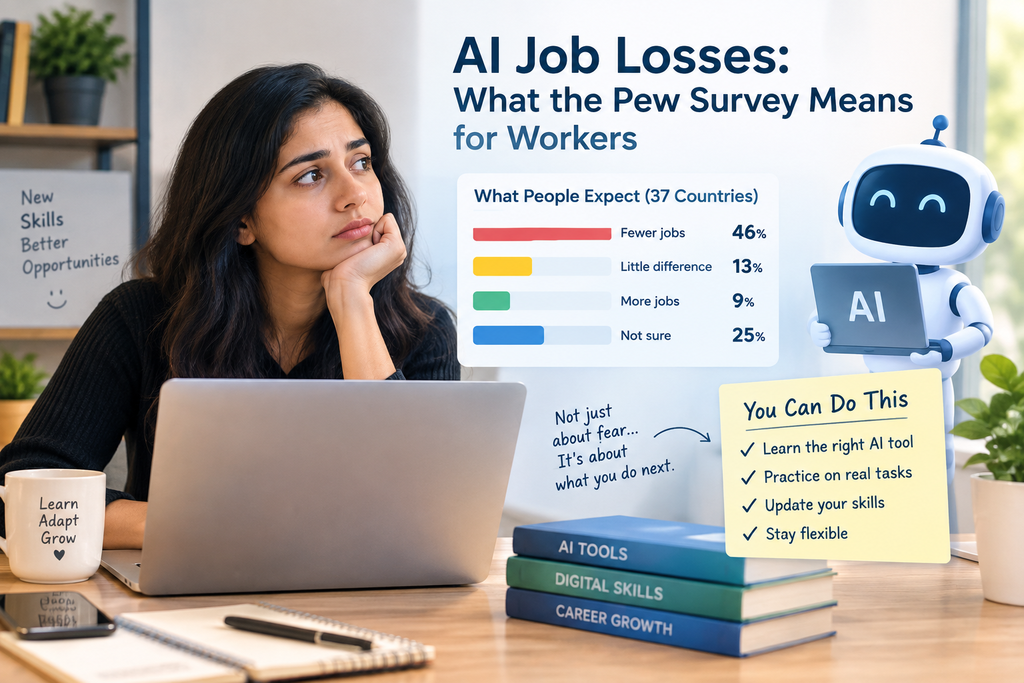
The numbers across all countries break down like this:
- 46% expect fewer jobs
- 13% expect little difference
- 9% expect more jobs
- 25% aren’t sure
The 37-country median puts 46% at fewer jobs, 13% at no big difference, 9% at more jobs, and 25% unsure. TechSpot
Wealth matters here. The median expecting fewer jobs is 55% in 18 high-income countries, against 36% in 18 middle-income countries. Search Engine Journal
| Country | Expect fewer jobs |
| Australia | 76% |
| South Korea | 76% |
| United States | 71% |
| 37-country median | 46% |
The U.S. figure is also rising. In the U.S., 71% predicted fewer jobs, an increase of 7 points over the past two years. Younger adults are part of that trend. In a number of countries, people aged 18 to 34 are the most concerned group, and in the U.S. their concern has grown the most. PressReaderTechSpot
Why This Isn’t a Prediction
These numbers describe feelings, not outcomes. Nobody knows what the job market will look like in 20 years, including the people answering the survey.
The “not sure” group tells its own story. In many places, about a fifth of adults or more are unsure how AI will affect their country’s jobs, and that reaches around four in ten in some middle-income nations. A Pew researcher noted that these respondents aren’t necessarily expecting more jobs. Many simply say they don’t know how AI will affect employment. Pew Research CenterPressReader
So the honest reading is that people feel worried and uncertain. Both reactions are fair, and both leave room for action.
A Real Example: One Marketing Team’s Shift
Here’s what I’ve seen up close. A digital marketing team started using AI to generate content ideas and handle basic data analysis. Those were routine jobs that used to eat a large share of their week.
The team didn’t shrink. Instead, people spent that saved time on strategy, creative work, and client communication. Those are the parts of the job where human judgment counts most.
That’s one team in one field, so treat it as an example, not a rule. Outcomes depend on how a company chooses to use the time AI frees up. Some employers cut roles. Others move people to higher-value work, as this team did.
The Most Common Mistake: Avoiding AI Out of Fear
The mistake I see most is people steering clear of AI because it feels threatening. It’s a natural instinct, but it backfires.
If AI job displacement reaches your field, the people who understand the tools will likely have more choices than those who avoided them. Avoidance doesn’t protect your role. It just narrows your options.
A better approach is to treat AI as a tool that supports your work and boosts your productivity.
How to Respond to AI Job Losses This Month
You don’t need a big plan. Try these four steps.
- Choose one AI tool that fits your job. Pick something relevant to your current field, not the newest tool on social media.
- Practice on real tasks. Use it for actual work, such as drafting, summarizing, or analyzing data.
- Update your skills to match changing requirements. Check recent job listings in your field and note which skills keep appearing.
- Stay flexible. Expect your role to shift, and treat learning as ongoing.
This won’t guarantee job security, and no plan can. But it moves you from worrying to doing.
Frequently Asked Questions
Will AI take jobs?
Some tasks and roles will shrink, and new ones will emerge. The Pew survey measures expectations, not certain outcomes.
Which countries worry most about AI and employment?
Australia and South Korea record the highest shares at 76% each, followed by the United States at 71%. ThePrint
Should I avoid AI tools to protect my job?
No. Learning to use them well usually gives you more options than staying away.
Where should I start learning?
Start with one AI tool related to your current work and use it on real tasks.
Conclusion: Adapt Instead of Fear
The Pew data shows that AI job losses worry people around the world, and that concern is growing in the U.S. Yet AI is changing jobs and creating new opportunities at the same time, especially for people who keep learning.
Your takeaway is to build skills, learn new tools, and stay flexible. This month, pick one tool and use it on a real task.
Source: Pew Research Center: Globally, More People Expect AI to Cause Job Loss Than Growth
SEO Package
- SEO Title (52 characters): AI Job Losses: What the Pew Survey Means for Workers
- Meta Description (155 characters): Pew finds most countries expect AI job losses over job gains. Learn what the data means, what one real marketing team did, and how you can adapt this month.
- URL Slug: /ai-job-losses-pew-survey-workers
- Primary keyword: AI job losses
- Secondary keywords: Pew Research AI survey, will AI take jobs, AI and employment, AI job displacement, workers’ fears about AI, future of work with AI
AI Job Losses: What the Pew Survey Means for Workers
If you’ve felt uneasy about AI job losses, you’re in good company. A new Pew Research Center survey shows that in most countries, more people expect AI to reduce jobs than to add them. That’s a lot of worried workers.
But worry doesn’t have to lead to paralysis. Below, I walk through what Pew found, what I’ve seen inside a real marketing team, and the steps that help most.
What Pew Found About AI Job Losses
Pew surveyed adults in 36 countries, and adding the U.S. brings the total to 37. In 34 of those 37 countries, more people expect AI to lead to fewer jobs than more jobs over the next 20 years. Search Engine Journal
The numbers across all countries break down like this:
- 46% expect fewer jobs
- 13% expect little difference
- 9% expect more jobs
- 25% aren’t sure
The 37-country median puts 46% at fewer jobs, 13% at no big difference, 9% at more jobs, and 25% unsure. TechSpot
Wealth matters here. The median expecting fewer jobs is 55% in 18 high-income countries, against 36% in 18 middle-income countries. Search Engine Journal
| Country | Expect fewer jobs |
| Australia | 76% |
| South Korea | 76% |
| United States | 71% |
| 37-country median | 46% |
The U.S. figure is also rising. In the U.S., 71% predicted fewer jobs, an increase of 7 points over the past two years. Younger adults are part of that trend. In a number of countries, people aged 18 to 34 are the most concerned group, and in the U.S. their concern has grown the most. PressReaderTechSpot
Why This Isn’t a Prediction
These numbers describe feelings, not outcomes. Nobody knows what the job market will look like in 20 years, including the people answering the survey.
The “not sure” group tells its own story. In many places, about a fifth of adults or more are unsure how AI will affect their country’s jobs, and that reaches around four in ten in some middle-income nations. A Pew researcher noted that these respondents aren’t necessarily expecting more jobs. Many simply say they don’t know how AI will affect employment. Pew Research CenterPressReader
So the honest reading is that people feel worried and uncertain. Both reactions are fair, and both leave room for action.
A Real Example: One Marketing Team’s Shift
Here’s what I’ve seen up close. A digital marketing team started using AI to generate content ideas and handle basic data analysis. Those were routine jobs that used to eat a large share of their week.
The team didn’t shrink. Instead, people spent that saved time on strategy, creative work, and client communication. Those are the parts of the job where human judgment counts most.
That’s one team in one field, so treat it as an example, not a rule. Outcomes depend on how a company chooses to use the time AI frees up. Some employers cut roles. Others move people to higher-value work, as this team did.
The Most Common Mistake: Avoiding AI Out of Fear
The mistake I see most is people steering clear of AI because it feels threatening. It’s a natural instinct, but it backfires.
If AI job displacement reaches your field, the people who understand the tools will likely have more choices than those who avoided them. Avoidance doesn’t protect your role. It just narrows your options.
A better approach is to treat AI as a tool that supports your work and boosts your productivity.
How to Respond to AI Job Losses This Month
You don’t need a big plan. Try these four steps.
- Choose one AI tool that fits your job. Pick something relevant to your current field, not the newest tool on social media.
- Practice on real tasks. Use it for actual work, such as drafting, summarizing, or analyzing data.
- Update your skills to match changing requirements. Check recent job listings in your field and note which skills keep appearing.
- Stay flexible. Expect your role to shift, and treat learning as ongoing.
This won’t guarantee job security, and no plan can. But it moves you from worrying to doing.
Frequently Asked Questions
Will AI take jobs?
Some tasks and roles will shrink, and new ones will emerge. The Pew survey measures expectations, not certain outcomes.
Which countries worry most about AI and employment?
Australia and South Korea record the highest shares at 76% each, followed by the United States at 71%. ThePrint
Should I avoid AI tools to protect my job?
No. Learning to use them well usually gives you more options than staying away.
Where should I start learning?
Start with one AI tool related to your current work and use it on real tasks.
Conclusion: Adapt Instead of Fear
The Pew data shows that AI job losses worry people around the world, and that concern is growing in the U.S. Yet AI is changing jobs and creating new opportunities at the same time, especially for people who keep learning.https://shikhav.com/
Your takeaway is to build skills, learn new tools, and stay flexible. This month, pick one tool and use it on a real task.
Source: Pew Research Center: Globally, More People Expect AI to Cause Job Loss Than Growth