Table of Contents
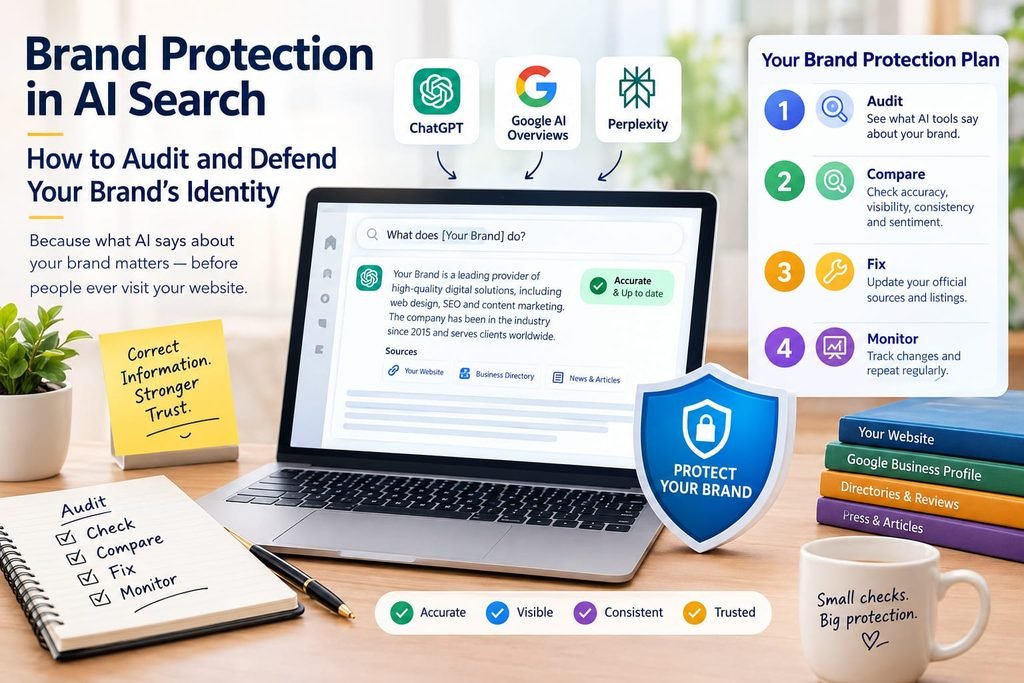
Brand protection in AI search is now part of basic brand management. Before people visit your website, many of them ask ChatGPT, Perplexity, or Google AI Overviews about you. If those tools describe your services wrongly, you may never see the lost trust or lost leads.
I’ve seen AI tools give outdated or inaccurate information about a brand’s services, positioning, and products. That experience is why I treat regular audits as a habit, not a one-time fix.
This guide shows you how to run an audit, fix what you find, and avoid the most common mistake.
Why Brand Protection in AI Search Matters
Traditional search shows a list of links. AI search gives one written answer. That answer may blend your website, old articles, review sites, and third-party listings into a single summary.
This creates three risks:
- Outdated facts. The tool may describe products or services you no longer offer.
- Wrong positioning. It may place you in the wrong category or price tier.
- Missing mentions. It may recommend competitors and skip you entirely.
AI tools can also produce hallucinations, meaning confident statements that aren’t true. You can’t fully prevent that. You can make the correct information easier to find and harder to misread.
The Biggest Mistake: Relying on Traditional SEO Alone
In my view, the biggest mistake is assuming traditional SEO is enough to control how AI presents your brand. Rankings help, but AI answers depend on how consistent and trustworthy your information looks across many sources.
If your website says one thing, your directory listing says another, and an old press page says a third, an AI tool has to guess. Consistency reduces the guessing. Google’s own guidance on AI features in Search explains that these features build on the same foundations as regular search, so strong basics still matter.
How to Run an AI Search Brand Audit
An AI search brand audit checks what AI tools say about you and whether it is accurate. Start simple.
Step 1: Pick your tools
Test the brand across ChatGPT, Google AI Overviews, and Perplexity. Each tool pulls from different sources, so results often differ.
Step 2: Use three types of queries
Run branded, product, and competitor-related searches. The examples below are illustrations, so swap in your own details:
- Branded: “What does [Brand] do?” or “Is [Brand] a good company?”
- Product: “What does [Brand]’s [product] cost?” or “Does [Brand] offer [service]?”
- Competitor: “[Brand] vs [Competitor]” or “Best [category] providers”
Step 3: Score each answer
Compare every response on accuracy, visibility, consistency, and any misleading claims. A simple table keeps this organized:
| Check | What to look for | Red flag |
| Accuracy | Correct services, products, and facts | Outdated or invented details |
| Visibility | Does the tool mention your brand at all? | Competitors named, you’re missing |
| Consistency | Same story across tools | Each tool tells a different story |
| Sentiment | Fair and balanced tone | Negative claims with no clear source |
Save screenshots and the date of each test. AI answers change, so dated records let you see progress.
How to Fix Wrong Information About Your Brand
Once you find errors, follow this process:
- Identify exactly what is wrong. Write down the specific claim, not just “it’s inaccurate.”
- Verify the correct information. Compare against your official, current sources.
- Update your official online sources with clear, consistent details.
- Monitor regularly to see whether the correction appears in AI answers.
Which sources should you update first?
Priority depends on your business, so treat this as general guidance:
- Your own website, especially About, services, and product pages
- Google Business Profile and other major profiles
- Directory and review site listings
- Press pages and older articles you control
- Wikipedia or similar sources, only where you’re eligible and following their rules
Adding structured data can also help machines read your details. Google’s structured data documentation is a good place to start.
One honest limitation: corrections can take time, and no one can guarantee that an AI tool will update on your schedule. Consistent sources improve your odds, but they aren’t a switch you can flip.
Your 30-Minute Brand Protection Plan
If you only have half an hour this week, do this:
- Spend 30 minutes checking how AI tools describe your brand, using a few key branded and product searches.
- Note every inaccurate detail.
- Make sure your official website and key online profiles clearly show the correct information.
That small routine catches most obvious problems early. Repeat it monthly or quarterly
Frequently Asked Questions
What is brand protection in AI search?
It means monitoring how AI tools describe your brand and correcting inaccurate or missing information at its source.
How often should I audit my brand in AI search?
Monthly works for most brands. Quarterly is a reasonable minimum if resources are tight.
Can I force ChatGPT or Perplexity to change an answer?
Not directly. You improve your chances by keeping official sources accurate and consistent, then monitoring results.
Is traditional SEO still important?
Yes. It’s just not enough by itself to control how AI presents your brand.
Conclusion
Brand protection in AI search comes down to a repeatable habit: test, compare, correct, and monitor. Start with a 30-minute audit, fix your official sources first, and keep your details consistent everywhere. Small, regular checks protect your brand’s identity far better than a rushed cleanup after something goes wrong.https://shikhav.com/