Table of Contents
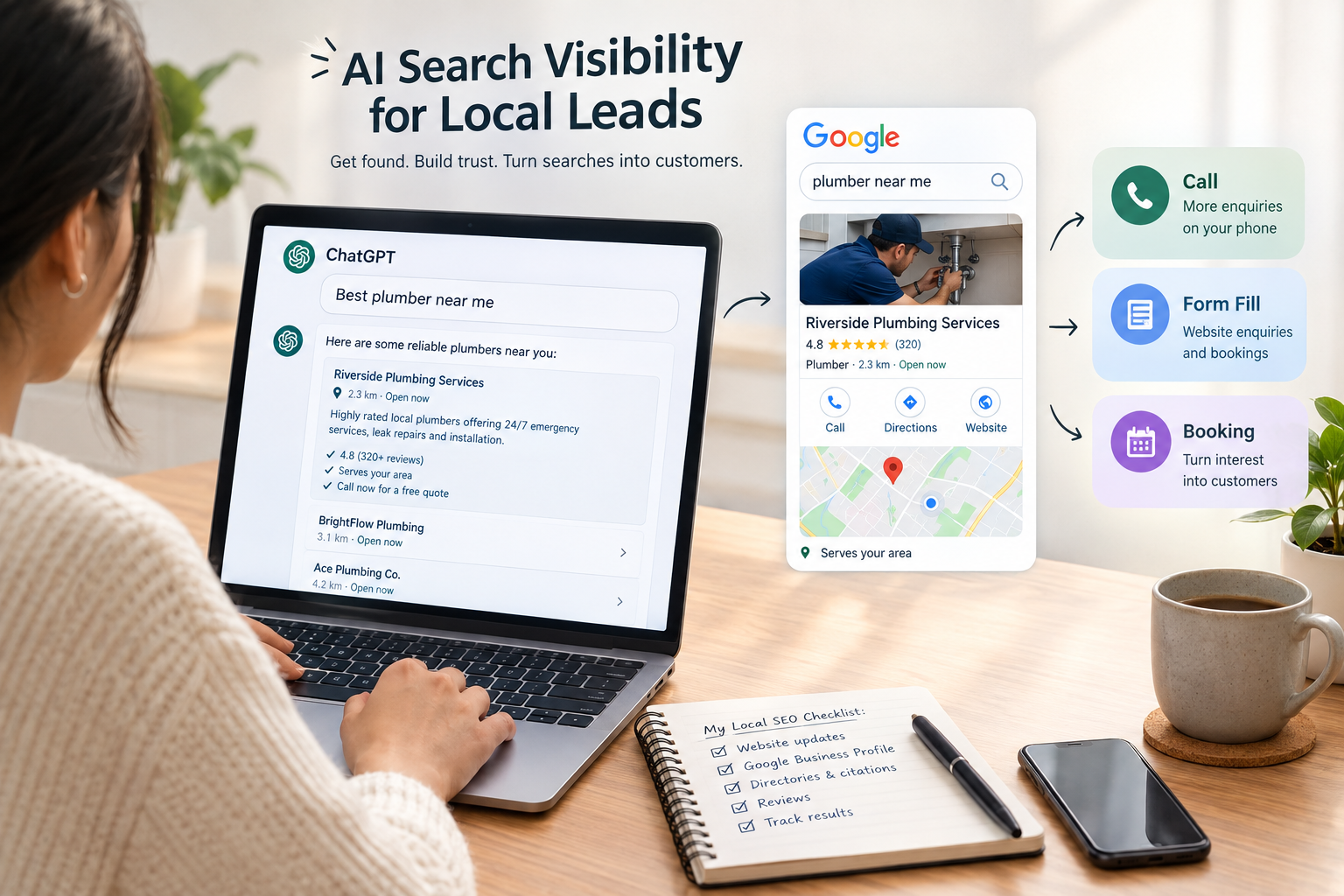
More people now ask ChatGPT or Google’s AI results for “the best plumber near me” instead of scrolling through ten blue links. If your business isn’t mentioned in those answers, you’re invisible to a growing group of buyers. But being mentioned isn’t enough. AI search visibility for local leads only matters when it ends in a call, a form fill, or a booking.
I help local businesses make that connection. In this guide, I’ll share the exact process I use, the fixes that matter most, and how I track results honestly.
What AI Search Visibility Means for Local Businesses
AI search visibility is how often, and how favourably, AI tools mention your business when someone asks a relevant question. That includes ChatGPT, Google’s AI Overviews, and similar tools.
For a local business, the question usually includes a service and a place. For example: “Who’s a reliable electrician in [your city]?” Your goal is to show up in that answer.
Google’s own guidance says the same SEO fundamentals apply to its AI features. You can read the details in Google Search Central’s documentation on AI features and your website. In other words, there’s no secret trick. Clear, trustworthy, well-organised information wins.
Step 1: Test What AI Tools Actually Say About You
Before I change anything, I run a simple audit. It takes about an hour, and it shows me exactly where a client stands.
- Search the business name in ChatGPT and Google’s AI results.
- Search each core service plus the location.
- Note whether the business is mentioned, recommended, or missing.
- Repeat the same searches for two or three top competitors.
- Record what the AI says, including any wrong details.
Then I compare the results. I look for gaps in local listings, reviews, website content, and overall online presence. Often, the competitor who gets recommended isn’t better. They’re just clearer.
Note: AI answers change from day to day. I run each test more than once and treat the results as a snapshot, not a final score.
Step 2: Fix Consistency First
In my experience, the biggest improvement comes from making local information consistent everywhere. AI tools appear to lean on clear, matching signals to work out what a business does, where it works, and whether people trust it. When those signals conflict, the business is easier to skip.
Here’s where I check first:
| Where | What I check | Common problem |
| Website | Services, service areas, contact details | Vague pages with no location info |
| Google Business Profile | Categories, hours, description, photos | Wrong category or outdated hours |
| Directories | Name, address, phone number | Old numbers or different business names |
| Reviews | Volume, recency, replies | Few reviews and no owner responses |
Fix your website first
Make it obvious what you do and where you do it. Give each main service its own page. Mention the towns or neighbourhoods you serve, and keep your contact details identical everywhere.
Then strengthen your Google Business Profile
Choose accurate categories and keep hours current. Follow Google’s guidelines for representing your business so your profile stays in good standing.
Clean up directories and reviews
Fix any listing that shows an old name, address, or phone number. Then ask happy customers for reviews on a regular schedule. Reviews build trust for people and for AI tools alike.
A Real Example From My Client Work
I worked with a local [business type, e.g., home services company] to improve its AI search visibility. We started with the audit above, then tightened its listings, reviews, and website content.
Within a few months, the business appeared more often in AI-generated local recommendations. That visibility led to more website enquiries and several qualified local leads. Some of those leads became new customers.
[Add: business type, city size, what you changed first, and the approximate number of leads or customers. Even a rough range makes this section far more credible.]
Results like this vary. A business in a crowded market with few reviews will need more time than one with strong reviews and a clean profile.
How to Track AI Search Visibility for Local Leads
This is where most people get stuck. AI tools don’t always pass clean referral data, so I use several methods together:
- UTM-tagged links on your website, profiles, and listings
- Analytics to spot new referral sources and rising branded searches
- Call tracking to see which numbers get dialled
- Lead forms with a “How did you hear about us?” field
What to do when tracking isn’t perfect
It won’t be perfect, and I tell clients that upfront. Some visitors see a recommendation, then search your name on Google later. That looks like a direct or branded visit in your reports.
So I add two more checks. First, I ask new leads how they found the business, either on the form or during the first call. Second, I watch overall enquiry trends month by month. When the audit results, the survey answers, and the enquiry trend all move in the same direction, the story gets more believable.
![Image placement 2: Before the tracking section]
The Most Common Mistake I See
Businesses focus only on keywords. They stuff service phrases into a page and hope AI tools take notice.
That approach misses the point. AI tools look at the whole picture: your website, profiles, reviews, and mentions elsewhere. A page full of keywords can’t make up for a weak local presence.
Here’s what I recommend instead:
- Keep your business information consistent everywhere.
- Create useful, location-specific content, such as answers to questions your local customers really ask.
- Collect and answer reviews regularly.
- Build local authority through partnerships, local press, and community links.
Frequently Asked Questions
Can I pay to appear in AI recommendations?
Not in the way you pay for ads. Visibility comes from clear, consistent, trustworthy information, not from a paid placement in most AI answers.
How long does it take to see results?
It varies. In my client work, I saw changes within a few months, but your timeline depends on competition, your starting point, and how quickly you fix the gaps.
Is AI search visibility different from local SEO?
They overlap heavily. Strong local SEO, such as an accurate profile, good reviews, and useful content, supports AI search visibility. The difference is that you also test what AI tools actually say and track leads that may not show up in normal reports.
Can I guarantee my business will be recommended?
No. Nobody can. AI answers change, and anyone promising a guaranteed spot is overselling.
Conclusion: Turn Visibility Into Leads
AI search visibility for local leads comes down to three things: test what AI tools say, fix your local signals, and track results honestly. Start this week by running the audit, then fix the most obvious inconsistency you find.
Don’t chase keywords. Build a clear, trusted local presence, and the leads will follow.
A freelance digital marketer in Kochi helps local businesses grow their online presence through effective digital marketing strategies. From SEO and social media marketing to Google Ads, content marketing, and website optimization, freelancers provide flexible solutions based on a business’s goals and budget. By understanding the local Kochi market and target audience, a freelance digital marketer can help businesses increase online visibility, attract potential customers, generate leads, and build a stronger digital presence.